

Space Service Market With Top Booming Companies At a CAGR of 8.8% by 2033
One of the most significant drivers of the market is the rising demand for satellite-based services, including telecommunications, earth observation, navigation
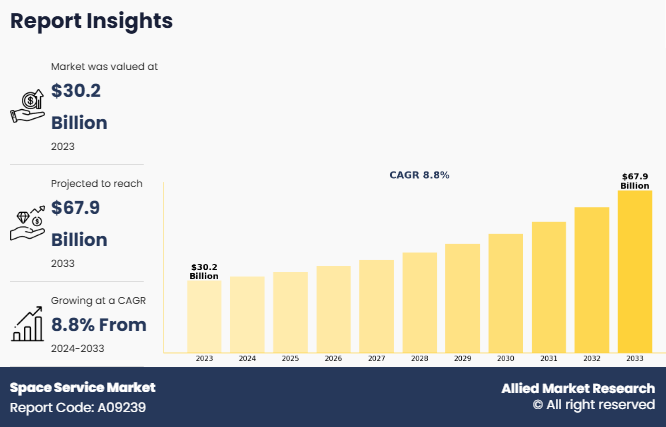
WILMINGTON, DE, UNITED STATES, December 10, 2025 /EINPresswire.com/ -- Allied Market Research published a report, titled, "Space Service Market by Service Type (Launch Services, Satellite Services, Space Exploration Services, and Ground Segment Services), by Satellite Type (Communication Satellites, Earth Observation Satellites, Navigation Satellites, and Scientific Satellites), Payload (Small Payloads and Large Payloads), Launch Vehicle Type (Reusable Launch Vehicles and Expendable Launch Vehicles), Application (Satellite Communication Services, Earth Observation and Remote Sensing, Navigation and Positioning Services, Scientific Research and Space Exploration, and Space Tourism and Commercial Spaceflight): Global Opportunity Analysis and Industry Forecast, 2024-2033". According to the report, the global space service market size was valued at $30.2 billion in 2023, and is projected to reach $67.9 billion by 2033, growing at a CAGR of 8.8% from 2024 to 2033.However, high costs associated with space missions and satellite deployments and regulatory and legal challenges in space operations are anticipated to hamper the growth of the market during the forecast period. Moreover, rise in demand for space tourism and commercial spaceflight and the expansion of in-orbit services are expected to offer lucrative opportunities for the market in the future.
Download Sample Pages of Research Overview: https://www.alliedmarketresearch.com/request-sample/A09239
The space service market is rapidly evolving, driven by advancements in propulsion technology, digital connectivity, and automation. The adoption of next-generation rocket engines, lightweight materials, and AI-powered monitoring systems is improving mission efficiency, sustainability, and cost-effectiveness. Growth in this market is fueled by rising demand for satellite services, space exploration, and commercial space travel. Companies are using data analytics, IoT-based tracking, and predictive maintenance to enhance satellite performance and reduce operational costs. In addition, new business models, such as satellite leasing, on-demand launch services, and space-based data solutions, are creating fresh revenue opportunities and shaping the future of the space industry.
Space services refer to a broad range of activities that support the operation, exploration, and commercialization of space. These services include launch services, which transport satellites and spacecraft into orbit using rockets from companies such as SpaceX and Arianespace. Satellite services involve operating and managing satellites for communication, navigation, and Earth observation, supporting applications such as disaster management, global internet connectivity, and climate monitoring.
Space exploration services focus on deep-space missions, lunar exploration, and Mars missions, often led by space agencies such as NASA in collaboration with private companies. Ground segment services provide infrastructure like satellite tracking stations and data processing centers to maintain communication with space assets.
LIMITED-TIME OFFER - Buy Now & Get Exclusive Discount on this Report @ https://www.alliedmarketresearch.com/checkout-final/d7c39e1aead6a5b651b15afc29a4baf5
Moreover, global navigation satellite systems (GNSS) such as GPS, Galileo, BeiDou, and GLONASS play a crucial role in location-based services, autonomous vehicles, and military applications. The expansion of precision navigation and real-time geospatial analytics is further driving the market growth. As industries continue to embrace space-based solutions, the market for satellite services is expected to grow exponentially, making it one of the most dominant segments within the broader space service industry.
In addition, the development of reusable launch technology is a significant driver of the growth in the space service market. Traditional space missions relied on expendable rockets, which could only be used once, making space access extremely expensive. However, with the introduction of reusable launch vehicles (RLVs), the cost of launching satellites, cargo, and even crewed missions has significantly decreased.
One of the biggest advancements in this area has been made by SpaceX, which pioneered the Falcon 9 and Falcon Heavy rockets with reusable first-stage boosters. These rockets are designed to return to Earth and land vertically, allowing them to be refurbished and flown multiple times. This technology has dramatically reduced launch costs, making it more affordable for businesses, governments, and research institutions to send payloads into space.
Enquiry Before Buying: https://www.alliedmarketresearch.com/purchase-enquiry/A09239
Moreover, companies such as Blue Origin and Rocket Lab are also investing in reusable launch systems. Blue Origin’s New Shepard rocket is designed for suborbital space tourism, while New Glenn, their upcoming heavy lift launch vehicle, will feature a reusable first stage. In addition, Rocket Lab has developed its Electron rocket with a partially reusable booster, further expanding cost-effective launch options.
In addition, reusable launch technology is increasing launch frequency and flexibility. Since rockets no longer need to be built from scratch for every mission, launch providers can offer more frequent launches, reducing waiting times for satellite operators. This is particularly important for constellation deployments such as Starlink, OneWeb, and Project Kuiper, which require large numbers of satellites to be launched regularly. As a result, reusable launch systems are playing a key role in shaping space service market share, allowing companies to reduce costs, enhance efficiency, and gain a competitive edge in the growing commercial space sector. This shift reflects key space service market trends, with a focus on cost-effective launch solutions, increased accessibility to space, and the rapid expansion of satellite networks globally.
The global space service market is expected to grow, driven by a rise in demand for satellite-based services, rise in private sector investments and commercialization, and advancements in reusable launch technology. However, high costs associated with space missions and satellite deployments, along with regulatory and legal challenges, are expected to hinder market expansion. Despite these challenges, growing interest in space tourism and commercial spaceflight, as well as the expansion of in-orbit services, are expected to create lucrative opportunities for future market growth.
Connect to Analyst: https://www.alliedmarketresearch.com/connect-to-analyst/A09239
The space service industry is segmented into service type, satellite type, payload, launch vehicle type, application, and region. On the basis of service type, the market is divided into launch services, satellite services, space exploration services, and ground segment services. As per satellite type, the market is segregated into communication satellites, Earth observation satellites, navigation satellites, and scientific satellites. On the basis of payload, the market is bifurcated into small payloads and large payloads. By launch vehicle type, the market is classified into reusable launch vehicles and expendable launch vehicles. As per application, the market is categorized into satellite communication services, Earth observation & remote sensing, navigation & positioning services, scientific research & space exploration, and space tourism & commercial spaceflight. Region-wise, the market is analyzed across North America, Europe, Asia-Pacific, and LAMEA.
By region, North America accounted for the largest market share and is anticipated to maintain its dominance till 2033, owing to high government spending, strong private-sector participation, and technological advancements. The region is home to leading space agencies such as NASA and major commercial space companies such as SpaceX, Blue Origin, and Boeing. However, the Asia-Pacific is expected to portray the highest CAGR of 9.8% during the forecast period, driven by increasing government investments, expanding private-sector participation, and technological advancements. Countries in the region are heavily investing in satellite programs, launch capabilities, and space exploration initiatives.
Leading Market Players: -
SpaceX
Blue Origin
Airbus
Lockheed Martin
Northrop Grumman
Eutelsat
Viasat, Inc.
SES
Maxar Technologies
Rocket Lab
Similar Reports:
Aerospace Bearings Market: https://www.alliedmarketresearch.com/aerospace-bearings-market-A14120
Aerospace Robotics Market: https://www.alliedmarketresearch.com/aerospace-robotics-market
Space Logistics Market: https://www.alliedmarketresearch.com/space-logistics-market-A47401
David Correa
Allied Market Research
+ + + + + + + + + + + + +1 800-792-5285
email us here
Visit us on social media:
LinkedIn
Facebook
YouTube
X
What Sets Us Apart ? - Allied Market Research
Legal Disclaimer:
EIN Presswire provides this news content "as is" without warranty of any kind. We do not accept any responsibility or liability for the accuracy, content, images, videos, licenses, completeness, legality, or reliability of the information contained in this article. If you have any complaints or copyright issues related to this article, kindly contact the author above.
